Evaluation of the project for the legal and emotional empowerment of women who have survived gender-based violence or are at risk of violence
Title ELENA – Empowerment Legale ed Emozionale per la Non violenza e l’Autonomia
Location Eastern neighbourhoods in Rome, Italy
Partners INTERSOS e CREG – Centro di Ricerche Economiche e Giuridiche dell’Università degli Studi di Roma Tor Vergata
Funding Fondo di Beneficenza di Intesa Sanpaolo
Context
The project ELENA – Legal and Emotional Empowerment for Non-violence and Autonomy – has been implemented to help reduce vulnerability and promote legal protection and psychosocial wellbeing amongst women who have survived, or are at risk of, gender-based violence, with a particular focus on migrant women.
Within the project, integrated and cross-cultural services have been set-up at the INTERSOS24 multi-purpose centre, located in the neighbourhood of Torre Spaccata. I24 is designed as a safe, low-threshold space where women can safeguard their rights and find emotional support and a listening ear.
The project involved women, both foreign and Italian, facing complex situations of violence, legal precariousness, economic dependence and social isolation, adopting a community-based, cross-cultural, intersectional and survivor-centred approach.
Alongside the individual legal support service – which focused on international protection, residence permits and family law – the beneficiaries were supported through group-based psychosocial programmes (emotional support and self- and mutual-help) aimed at facilitating trauma processing and the restoration of self-esteem and decision-making power.
Alongside direct support, the project has also invested in specialist training for local practitioners, third-sector professionals and university students (focusing on gender-based violence, migration law and intercultural issues), in strengthening the local multi-stakeholder network (through collaboration with CPIA, reception centres and local services) and in group legal information sessions aimed at raising awareness amongst women and the community about their rights and the protection services available.
General Objective
The M&E and Impact Assessment Unit was tasked with carrying out the project evaluation and establishing learning pathways.
Our contribution
To evaluate the project, the ARCO research team employed mixed-methods approaches, combining qualitative and quantitative methods.
The evaluation drew on feminist participatory research methods, ensuring that the beneficiaries’ stories were actively listened to through the accounts of the project workers or their direct involvement (where possible), as well as through questionnaires on multidimensional well-being, direct observation by the evaluator and the analysis of secondary data.
The integration of these different sources made it possible to reconstruct not only what changes had taken place, but also how and through which mechanisms the project had helped to bring them about.
The analysis is based on a conception of empowerment as an individual and collective process, which concerns women but also the system of relationships and the context in which they are embedded: the family, the community and, more generally, society.
This perspective aligns with Amartya Sen’s Capability Approach, according to which agency and freedom of choice are central to expanding the opportunities actually available to people to pursue what they value. In the case of women, this means, for example, being able to lead a healthy life, look after themselves, access knowledge and decent work, build relationships, participate in social and public life, and live a life free from violence.
To analyse these changes, ARCO applied its own framework for analysing multidimensional empowerment, structured around three closely interlinked dimensions: Potential empowerment (power within), which concerns the inner resources that enable women to recognise themselves as agents capable of taking action; Individual functioning (power to and power with), which concerns the translation of these resources into concrete opportunities for choice and action in everyday life; and collective and territorial functioning, which concerns the contextual conditions that may foster or hinder empowerment.
In this way, the assessment made it possible to view empowerment not as a single outcome, but as a process: from the growth of awareness and confidence in one’s own abilities, to the possibility of translating these into concrete choices and actions, right through to the local conditions that make such possibilities effectively realisable.
Finally, particular attention was paid to ensuring the ethical conduct of the data collection process, guaranteeing that methods used were safe, respectful and non-invasive. Specific precautions were put in place to avoid any risk of secondary victimisation, including careful wording of the questions, a thorough selection of participants and constant attention to their safety – both physical and emotional – as well as to the potential triggering of potentially traumatic situations or memories. The entire process was characterised by an empathetic, non-judgemental approach based on active listening, treating the women as individuals with rights rather than as subjects of investigation.
 La valutazione femminista parte dal presupposto che il genere conta.
Related Projects
-

Women in Safety, evaluation of the project to support women who have survived gender-based violence in Rome
-
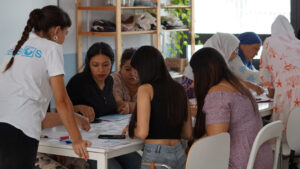
Evaluation of the project for the legal and emotional empowerment of women who have survived gender-based violence or are at risk of violence
-

Valutazione intermedia e finale del progetto “Bella Storia. La tua.” per la crescita culturale e personale dei giovani in Calabria e Campania
-

Final evaluation of the project to contrast educational poverty in Bergamo province
-

Final evaluation of the project fostering education, training and food security for Afghan women
-

Impact Evaluation of the Maziwa initiative that helps achieve food security in Meru County, Kenya
-

Evaluation of the project that promotes inclusive education for street connected children and/or children with disabilities in Kenya
-

Support for the creation of a feminist monitoring and evaluation framework for the Rel.Azioni Positive Anti-Violence Centre
-

Evaluation of the No More Violence project promoting quality services for women victims of gender-based violence
-

Evaluation of the call “A Braccia Aperte” for systemic multidisciplinary intervention to support special orphans
-

Accompanying the digitisation process of monitoring and evaluating the project for the economic and social empowerment of women in SAHEL
-

Evaluation of the project Prato Comunità Educante that promotes the education growth of high school students in Prato
-

Monitoring Information System for project WATDEV on water management and sustainable development in East Africa
-

Research on knowledge, attitude, social norms and practice on reproductive health rights and gender-based violence in Narok county, in Kenya
-

Evaluation of the project that promotes food security and climate resilience in Mozambique
-
Evaluation and training for the REACH OUT project staff that aims at strengthening migrants’ right to health in Italy, Greece and Malta
-
Final evaluation of the project that strengthens olive farmers’ resilience in Southern Lebanon
-
Social impact assessment of the Rapporti Corti project for socio-educational inclusion in the Navile district of Bologna
-

Evaluation of the Naseej project to stop gender-based violence in Iraq, Yemen, and Palestine
-
Evaluation of the project that promotes youth employment in Italy
-
Final evaluation of the ‘5G Smart School’ project for innovative teaching in Italian schools
-
Evaluation of the project that fosters mainstreaming migration into international cooperation and development policies
-

Final evaluation of a project to contrast educational poverty in Albania
-
Evaluation of the project PRODECREO to promote the rights and socio-occupational reintegration of women deprived of their liberty in the Dominican Republic
-

Final evaluation of the SOS Children’s Villages family strengthening project in Bosnia and Croatia
-
Final evaluation of the project that fosters proximity social-health services in the informal settlements of the Province of Foggia
-

Food Wave, Monitoring the project that promotes sustainable food consumption among young Europeans
-

Spazio Donna, evaluation of the projects to foster women empowerment and contrast gender-based violence
-

Evaluation of the projects “M’Interesso di Te” that tackle unaccompanied foreign minors’ integration
-
Evaluation of psycho-socio-sanitary interventions in response to the COVID-19 pandemic and the earthquake in Albania
-

Final evaluation of the Youth For Love project to raise young people’s awareness of gender-based violence
-
Multi-country mid-term evaluation of the YouthCan! programme, promoting the employability of vulnerable young people
-

Final evaluation of WEGO2 to support women economic empowerment contrasting intimate partner violence
-
Action Research for the project Do.N.N.E against gender-based violence in Central Italy
-

Evaluation of the project “Mentors for Resilience” to contrast educational poverty
-
Outcome Harvesting of the project that aims to promote stability and social enterprise in Lebanon
-
Annual evaluation and SROI of the programme “Nessuno Escluso” to contrast social exclusion and educational poverty in Tuscany
-
Evaluation of the project “Dreams and Needs” to contrast educational poverty in Italy
-
Mid-term evaluation of the project MilKy for the development of a sustainable dairy supply chain in Kenya
-

Final evaluation of Pe.R.Co.rrere: resilience of communities in Center Italy
-
Evaluation of the promotion campaign for Piave DOP cheese in Austria, Germany and Italy
-
Mid-term & final evaluation of a project to strengthen resilience to climate shocks in Kenya
-
Evaluation of the promotion campaign for Italian specialities in Japan
-
Community center, final evaluation of the social inclusion project
-
Mid-term evaluation of the project to contrast irregular migration in Ethiopia
-
Mid-term evaluation of the project for the conservation of Protected Areas in Albania
-
Social Impact Assessment of children’s protection programmes in Kyrgyzstan
-
Monitoring&Evaluation of reintegration services for drug addicts and ex-addicts in Lebanon
-
SROI Analysis, Albergo Etico social performance
-
ECO.COM: strengthening local economic development in Bolivia
-

Improving the sustainability in the cherry supply chain in Bulgaria and Turkey
-
Evaluating sustainable agricultural supply chains in Bosnia Herzegovina and Albania
-
Impact evaluation of the creation of a durum wheat supply chain in Ethiopia
-
Impact evaluation of a Rehabilitation programme in India